
Shakopee City Directory Collections and Substitutes
No official source reviewed for Shakopee exposes a complete city-directory run, a reverse directory, or a viewable local entry. That gap matters. It means no year range, publisher, or sample listing should be assumed. Instead, begin with the Scott County Historical Society and Scott County Library, state the name or address and the year window, and ask staff whether a city, address, telephone, or criss-cross volume is actually held. Shakopee historical research can still move forward through named collections that preserve the setting around a household.
| Collection or lead | Years | Where held | Access |
|---|---|---|---|
| Shakopee city, address, telephone, or criss-cross volume | Not verified online | SCHS or Scott County Library staff | Request a volume, year, and page check |
| Shakopee newspaper microfilm | 1856-2014 | Scott County Historical Society | Onsite research help |
| Plat maps | 1854-1974 named series | Scott County Historical Society | Onsite maps and smaller plats |
| Sanborn Fire Insurance Maps | 1884, 1890, 1895, 1902, 1910, 1935 | Scott County Historical Society | Onsite map review |
| State and federal census material | 1857-1950 on the current holdings page | Scott County Historical Society | Confirm the shelf range onsite |
The current SCHS page gives a 1857-1950 census range, while an older official version gave 1857-1920. Record that discrepancy in research notes and confirm the material in person. A negative answer should name the series checked, not turn into a claim that nobody lived at a Shakopee address.
The Shakopee City Directory Gap
Shakopee has strong historical repositories, yet their published inventories do not identify a complete city-directory, telephone-book, or criss-cross run. The Scott County Historical Society holdings list does identify maps, newspapers, registers, card files, census materials, family histories, and other local sources. Those records offer a careful substitute when an actual directory volume cannot be confirmed. They also keep a researcher from copying generic directory years into a Shakopee search.
The historical society’s public holdings inventory is shown below.

Use the inventory as a menu for a targeted request, not as proof that a particular city-directory volume exists. A useful request asks staff to check Shakopee city, address, telephone, or criss-cross holdings for a name or address within a stated year window and report the exact title, volume, page, spelling, and whether the list is by person or by street.
Note: An online catalog gap is a reason to contact the repository, not proof that a historical household left no records.
Shakopee City Directory Clues in Newspapers
SCHS holds Shakopee newspaper microfilm from 1856 through 2014. A newspaper does not work like a city directory, but a dated announcement, obituary, civic report, or advertisement can place a name, organization, and sometimes an address in a particular period. Search a full name with a date range, then record the publication title, issue date, page, exact spelling, and the type of mention. That citation lets another researcher separate one same-name person from another.
For a Shakopee household, compare an announcement with the address or legal description found in a map or land record. An obituary card or marriage-announcement card can also lead to a surname variation. It cannot establish continuous residence, and an advertisement may identify a business rather than a home. The value is the dated connection and the source citation, not an unsupported conclusion.
Shakopee City Directory Addresses Through Maps
When an older Shakopee address is missing or described by a lot rather than a modern street number, SCHS plat maps can bridge the language. Its named plat series spans 1854, 1880, 1898, 1913, 1944, 1952, 1958, 1963, and 1974. The maps support a comparison of lot, block, subdivision, township, and later street geography. They do not identify every person who lived in a building.
The six Shakopee Sanborn dates, 1884, 1890, 1895, 1902, 1910, and 1935, add building footprint and use context. Compare the same block across dates, then keep the map date distinct from any person record. The city’s historical setting includes a trading post era, rail and highway development, and later urbanization, so an old description may require a plat or township term before it can be matched to a current map.
Reading a Shakopee City Directory Entry Carefully
Because no viewable Shakopee directory entry was found, staff should confirm what any located volume actually prints. Historical city directories commonly organize people by name and may include an address, occupation, spouse notation, or an abbreviation key. A later volume may offer a street-ordered section. Treat each item as a field to verify in the specific Shakopee volume rather than as a promise about every local directory.
| Name spelling | Ask staff to report the exact printed name, initials, and any alternate spelling. |
|---|---|
| Address | Confirm whether the listing is a home, business, street order, or another type of address. |
| Occupation or organization | Record it only if the specific volume includes it, with the page citation. |
| Household notation | Confirm whether spouse, widow, owner, renter, or relationship marks appear in that edition. |
| Abbreviations | Request a copy of the volume’s key before interpreting short forms. |
- Criss-cross directory
- A directory arranged by address or street rather than by personal name. No verified Shakopee run was located online.
- Householder index
- A name or address index that may identify the household head, depending on the specific publication.
- Abbreviation key
- The publisher’s explanation of shortened terms and symbols. It should be read with the entry, not guessed.
Library Help for Shakopee City Directory Research
The Scott County Library genealogy service offers hands-on help with census, military history, cemetery research, workshops, and free resources. Its Ancestry Library Edition access is for use in the library and includes census, vital, directory, and photo records. Shakopee Library is at 235 Lewis Street South, and the research file lists 952-233-9590. Staff can help distinguish a collection title from an actual Shakopee directory volume.
The county library’s genealogy service appears below.

For a difficult historical question, the Ask a Librarian form accepts a question, what was tried, and collection details, though the captured form requires a 14-digit library card number. Give a name, variant spelling, old address, year window, and request for a title and page. That is more useful than asking for a general person search.
Shakopee Family History Beyond the City Directory
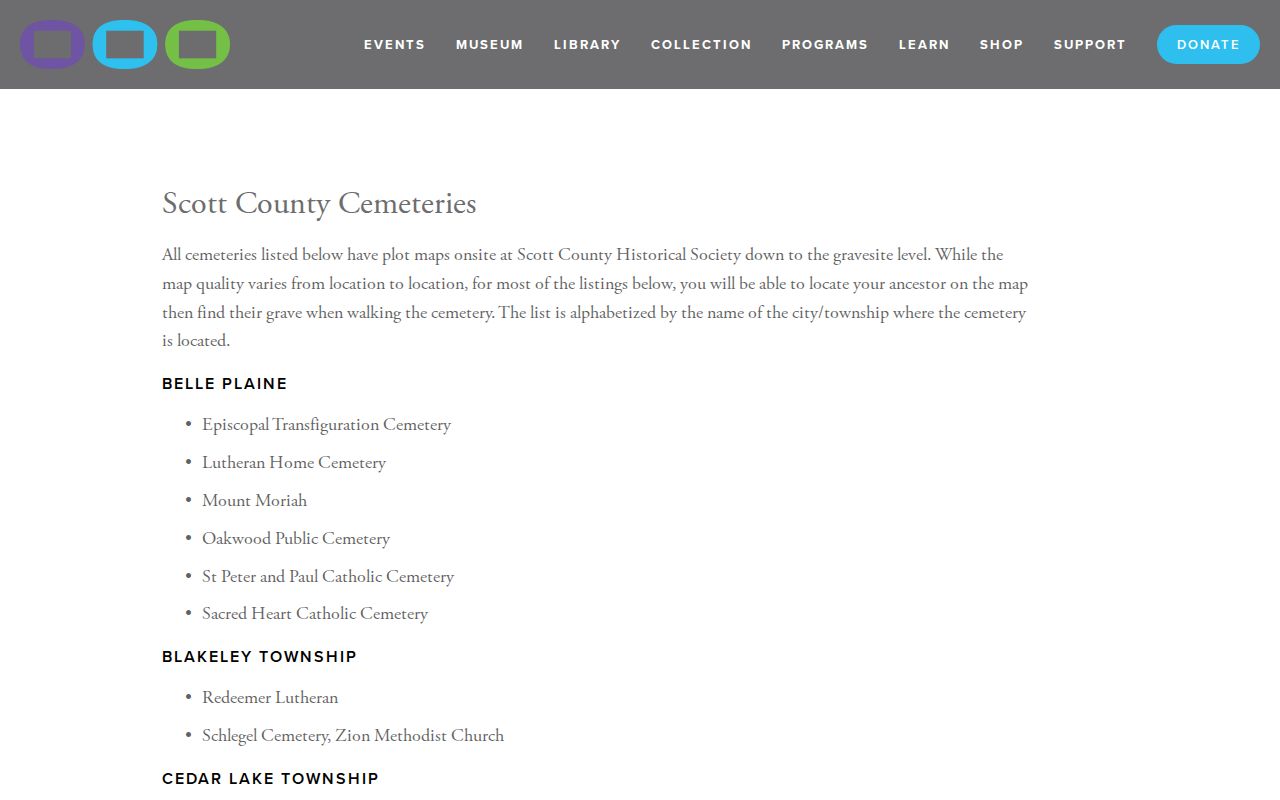
Census, church registers, cemetery plot maps, obituary cards, and family-history books build the household layer when a Shakopee city directory cannot be located. SCHS reports baptism, marriage, and death registers for most county churches, plus cemetery maps that lead to gravesites. The SCHS cemetery list includes a Shakopee section. A burial place is a family-history clue, not evidence of a current address.
The public cemetery-record route is shown below.
For relationship evidence, FamilySearch Minnesota Will Records displays Scott County coverage of 1857-1970 with index and images. A will may name a testator, spouse, heirs, executor, witnesses, dates, and residence details. Verify the original record and do not turn one relationship reference into a full residence history.
Trace a Shakopee City Directory Household
Start only after staff identify an actual Shakopee city directory or address-volume hit. Pair each confirmed listing with an independent source from the same period. That approach handles moves, name variants, and gaps without treating a single entry as a complete biography.
- Ask SCHS or the library for the exact title, year, volume, page, and whether the result is name ordered or street ordered.
- Copy the spelling, address, abbreviations, and every stated role exactly as printed.
- Compare the address with the appropriate plat or Sanborn map and record the map date separately.
- Pair the period with the available census material, then note whether the census range was confirmed onsite.
- Use a newspaper, church, cemetery, or will record to test a move, death, marriage, or family connection.
A disappearance from a directory can mean a move, a name change, a death, an unlisted person, or a missing volume. Write down the alternate explanation and the source that could test it. For a current parcel or deed trail, use the Shakopee Street Directory rather than assuming a historic address shows present occupancy.
Shakopee Records Timeline for Directory Research
Shakopee’s record geography changed as the community grew, but the research found no verified directory-publication timeline. The safer timeline below identifies the local collections that can be dated. It does not fill the city-directory gap with inferred publishers or years.
- 1851: Shakopee began as a trading post near the Dakota village of Chief Shakopee, according to SCHS county history.
- 1854: The earliest named SCHS plat-map year provides an early lot-and-block route.
- 1856: Shakopee newspaper microfilm begins in the SCHS holdings.
- 1857: Shakopee was incorporated, and the current holdings page begins its listed census range.
- 1884-1935: Six dated Sanborn snapshots document buildings and street context.
Keep each result with its repository, title, date, page or map sheet, exact text, and a note on confidence. That record trail makes Shakopee historical research repeatable when another collection becomes available later.
Note: Confirm repository hours, request rules, and collection availability before making a Shakopee research visit.